
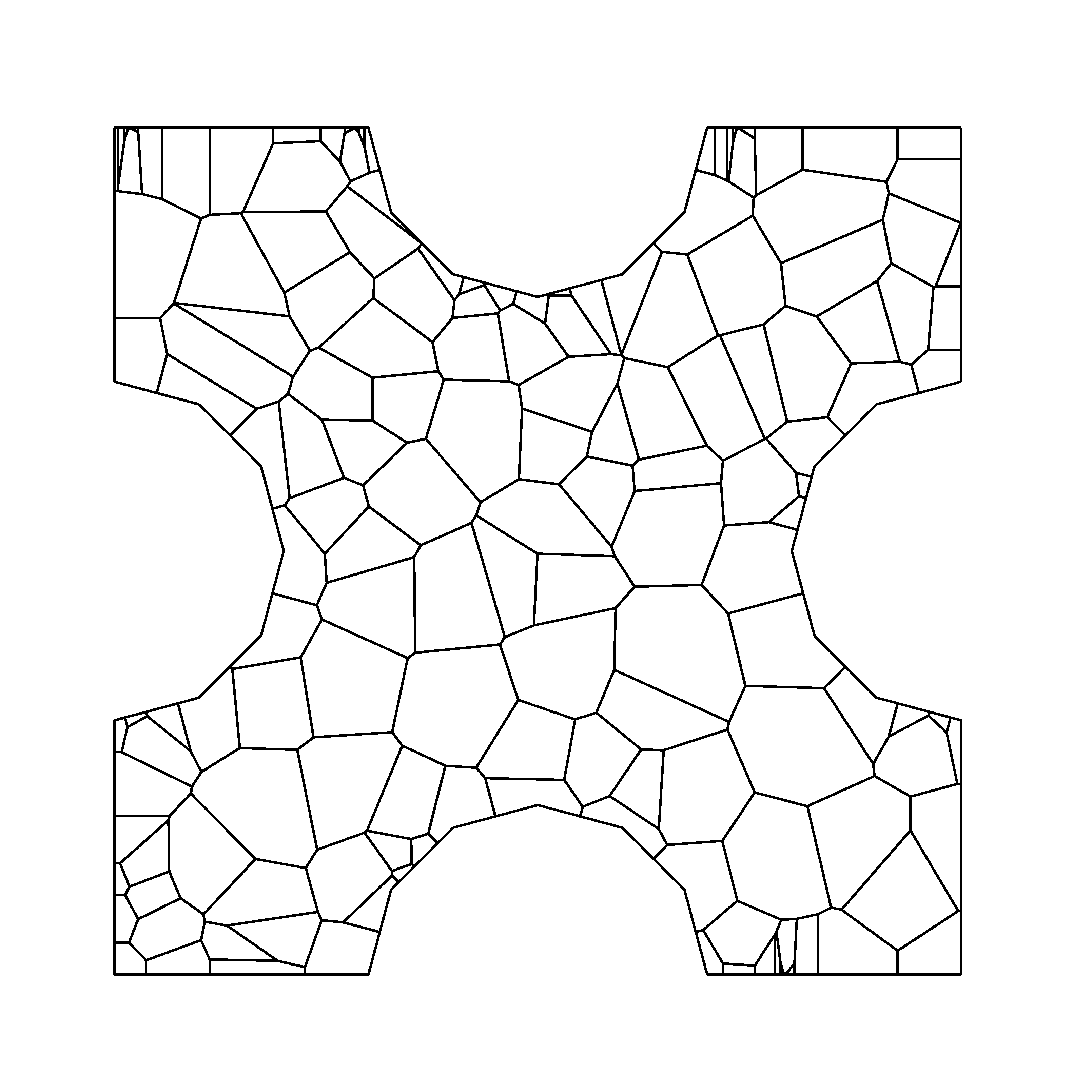
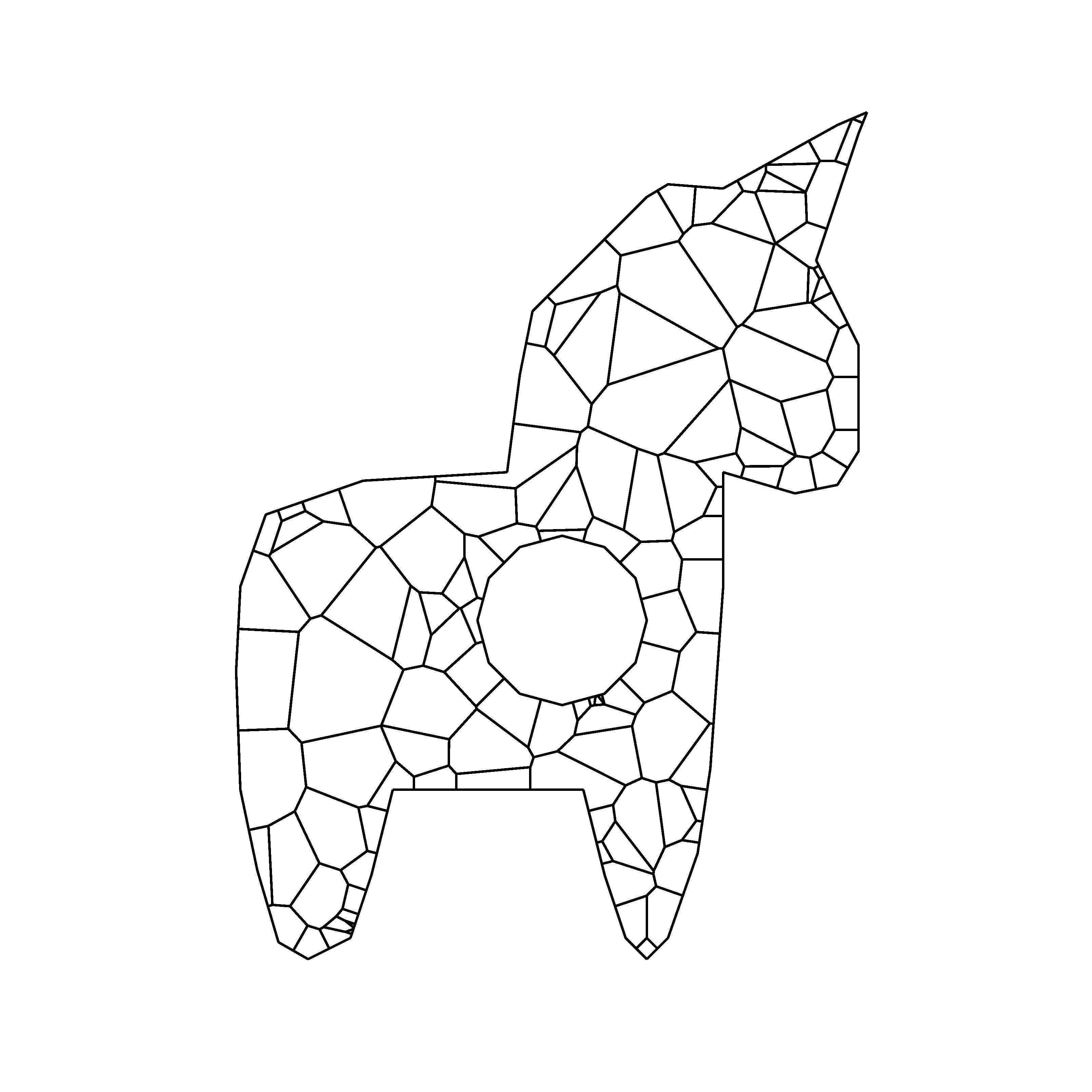
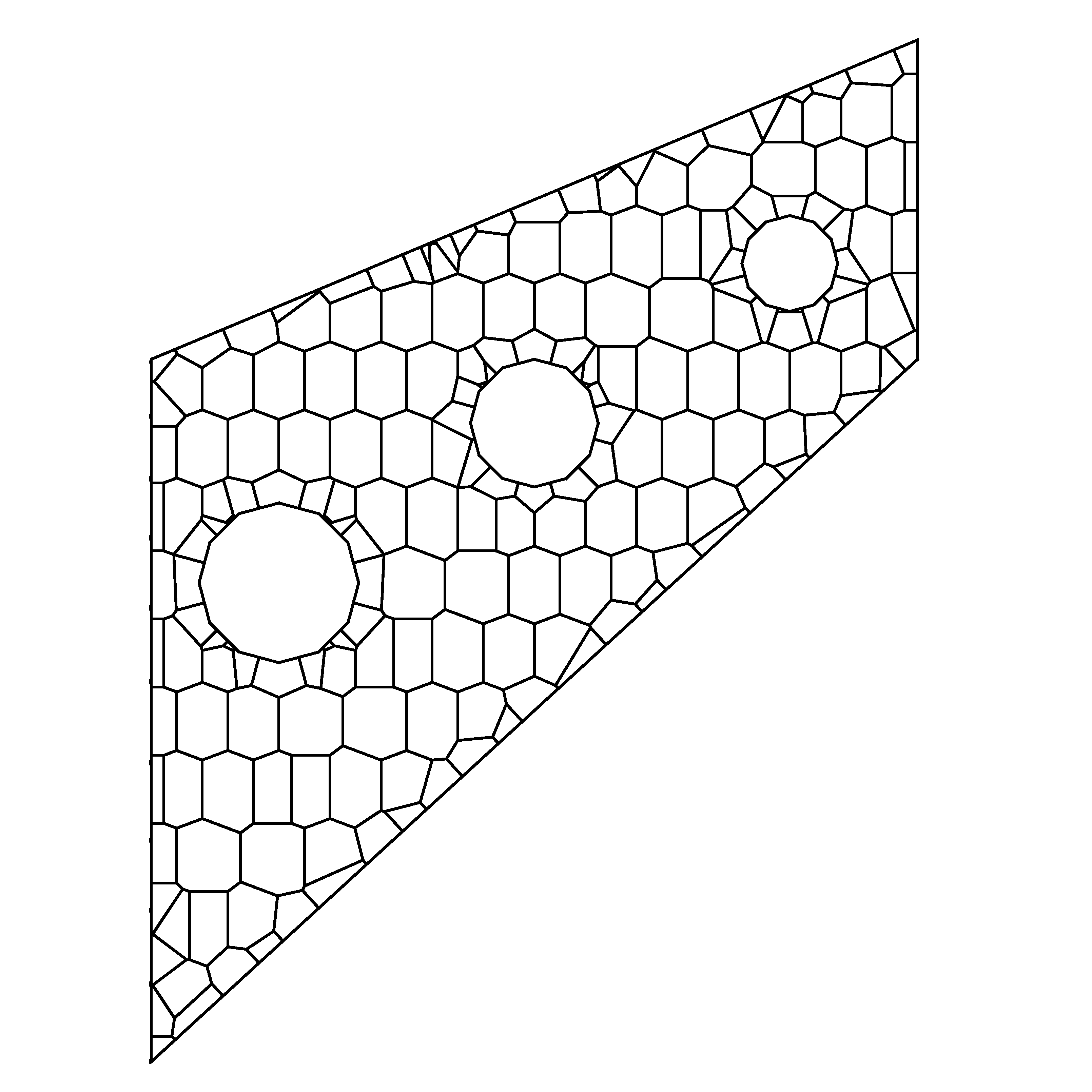
Features
Free and open source C++ library for the generation of polygonal meshes on arbitrary domains, based on the constrained Voronoi diagram. It is the built-in polygonal mesh generator of theVeamy library.
- The meshes are generated on arbitrary domains, created from user defined points. Domains have no restrictions on convexity.
- It allows the inclusion of completely contained or intersecting holes, which are processed if required.
- The meshes are generated from seed points, which can be read either directly from a text file, included one by one, or created from a number of generation rules included in the library. New generation rules can be easily included.
- Meshes can be stored in OFF-style text files, or used directly in another program.
- To generate the meshes, the library first computes the conforming Delaunay triangulation using Triangle; the triangulation is considered as a mesh that is left available for use if needed. Then, it computes the constrained Voronoi diagram.
Author
Catalina Alvarez – B.Sc., M.Sc., Universidad de Chile.
Supervisors
Nancy Hitschfeld-Kahler – Associate Professor, Department of Computer Science, Universidad de Chile.
Alejandro Ortiz-Bernardin – Associate Professor, Department of Mechanical Engineering, Universidad de Chile.
Usage instructions
Delynoi is currently for Unix systems only.
- Download the source code and unpack it.
- In the root directory of Veamy, create a
build/folder. - Go to test/ folder located in the root directory of Delynoi and: (a) add the main C++ file (say,
mytest.cpp) containing your test example problem, (b) modify theCMakeLists.txtby changing the file nameexample.cppin
by the name of your main C++ file (in this case,set(SOURCE_FILES example.cpp)mytest.cpp) - Inside the
buildfolder and in the command line type:
to create the makefiles. And to compile the program type:cmake ..make - To run your example, go to the
build/test/folder and in the command line type:./Test
Usage example
To generate a polygonal mesh, one needs to:
- List, in counterclockwise order, the points that define the domain and create the domain as a Region instance:
std::vector square_points = {Point(0,0), Point(10,0), Point(10,10), Point(0,10)}; Region square(square_points); - Include the required seed points on the domain, for which there are three alternatives:
- Create the points as a list of Point instances, and call:
std::vector seeds = {Point(5,5)}; square.addSeedPoints(seeds); - With the points coordinates listed on a text file, say
seeds.txt(an example is found in the test folder), call:square.addSeedsFromFile("seeds.txt"); - Decide on two generation rules (one for each axis) from the predifined list of functions (or create a new one inheriting following the instructions given in the manual), and create a PointGenerator instance. If required, include a noise function from the noise list provided. Then, call including the PointGenerator and the number of points on each axis:
PointGenerator rules(functions::random_double(0,10), functions::random_double(0,10));
int nX = 5, nY = 5;
square.generateSeedPoints(rules, nX, nY);
- Create the points as a list of Point instances, and call:
- Create a TriangleVoronoiGenerator instances with the points inside the domain, and the domain itself:
std::vector seeds = square.getSeedPoints(); TriangleVoronoiGenerator generator (seeds, square); - To obtain the Voronoi diagram, call:
Mesh voronoi = generator.getMesh(); - To use the Delaunay triangulation instead of the Voronoi diagram, a different class is used, TriangleDelaunayGenerator, which can return the constrained Delaunay triangulation or the conforming Delaunay triangulation:
TriangleDelaunayGenerator generator (seeds, square);
Mesh constrained_delaunay = generator.getConstrainedDelaunayTriangulation();
Mesh conforming_delaunay  = generator.getConformingDelaunayTriangulation();
It is also possible to define a number of constrained segments inside the domain, that will not be flipped when the Delaunay triangulation is computed:
Mesh constrained_delaunay = generator.getConstrainedDelaunayTriangulation(restrictedSegments); - To print the mesh to a text file use:
mesh.printInFile("mesh.txt");
Acknowledgements
Delynoi depends on two external open source libraries, whose source codes are included in the repository.
- Triangle – A Two-Dimensional Quality Mesh Generator and Delaunay Triangulator.
- Clipper – an open source freeware library for clipping and offsetting lines and polygons.
License
This project is licensed under the GPL License. This program is free software; it can be redistributed or modified under the terms of the GNU General Public License as published by the Free Software Foundation.
Download
>> Latest stable version of Delynoi (7-April-2019): Delynoi v2.0
Download:Source code (zip) | Delynoi Primer (PDF manual)
GitHub: Browse the source code on GitHub