
A. Ortiz-Bernardin and Edoardo Artioli
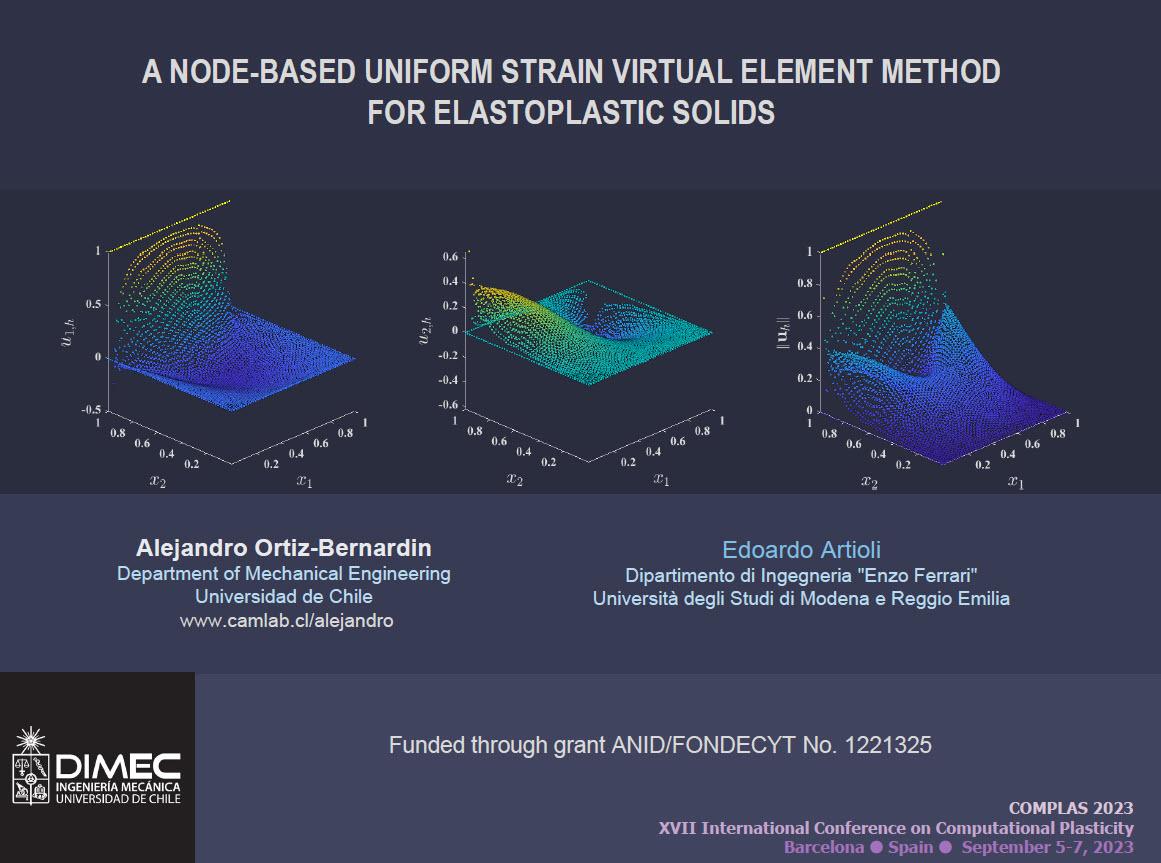
Abstract. This work presents our recent advances on developing the extension of the node-based uniform strain virtual element method (NVEM) [1] to elastoplastic applications. In this method, the strain is averaged at the nodes from the strain of surrounding virtual elements using a nodal averaging operator that is constructed alike the node-based uniform strain approach for finite elements [2]. In this scheme, the lowest-order virtual element approximation is used without introducing additional degrees of freedom, thus resulting in a displacement-based formulation. A distinct feature of the NVEM is that the state and history-dependent variables are stored and tracked directly at the nodes, which facilitates the handling of the history variables within the nonlinear solver and the postprocessing. Through some standard benchmark problems in small strain elastoplasticity, we demonstrate that the NVEM enables the lowest-order virtual elements to solve solid mechanics applications involving compressible and nearly incompressible elastoplastic solids with accuracy and robustness.
Keywords: virtual element method, nodal integration, strain averaging, uniform strain, linear elasticity, elastoplasticity, volumetric locking.
References
- Ortiz-Bernardin A., Silva-Valenzuela R., Salinas-Fernández S., Hitschfeld-Kahler N., Luza, Rebolledo B., A node-based uniform strain virtual element method for compressible and nearly incompressible elasticity, International Journal for Numerical Methods in Engineering, Early View, 2022.
- Dohrmann C.R., Heinstein M.W., Jung J., Key S.W., Witkowski W.R., Node-based uniform strain elements for three-node triangular and four-node tetrahedral meshes, International Journal for Numerical Methods in Engineering, Vol. 47 (9), pp. 1549-1568, 2000.